Fish of the Thunnus genus of the tribe Thunnini of the subfamily Scombrinae of the Scombridae family of the Scombroidei suborder of the Scombriformes order of the Percomorpha clade of the Acanthopterygii superorder.
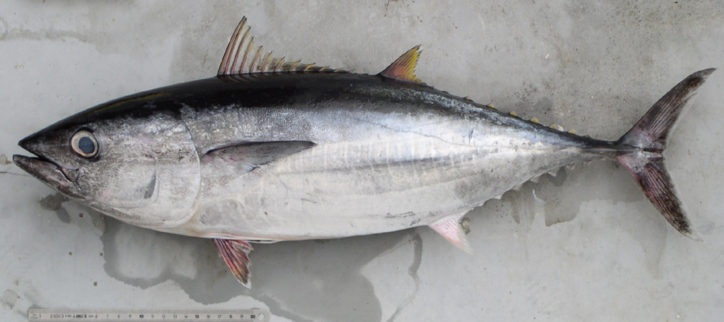
(Atlantic bluefin tuna. Photo © Muséum national d’Histoire naturelle (S. Iglesias). fishbase.org)
Atlantic bluefin tuna (Thunnus thynnus) was first described in 1758 by the Swedish naturalist Carl Linnaeus (1707-1778).
It is a pelagic schooling species. It inhabits the depths of up to 985 meters, usually up to 100 meters. The maximum recorded length is 458 cm, specimens up to 200 cm long are more common. The maximum weight is 684 kilograms. It feeds on fish, crustaceans, and squid.
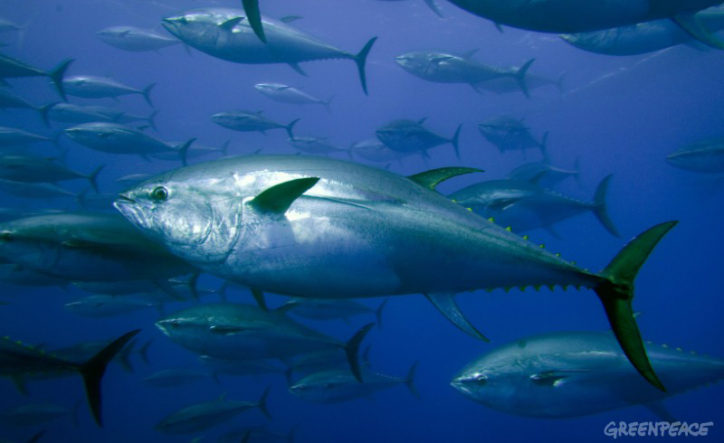
(Atlantic bluefin tuna. Photo © Greenpeace / Gavin Newman. greenpeace.org)
It is a permanent inhabitant of the Adriatic Sea.
It is listed in IUCN Red List as an endangered species (EN).
Names of Atlantic bluefin tuna (Thunnus thynnus) in other languages as follows:
Kërmilli i dunave, Toni (Albanian), Тон (Ton) (Bulgarian), Kékúszójú tonhal (Hungarian), Blauwvintonijn (Dutch), Ερυθρός τόνος (Erufros tonos), Τόνος (Tonos) (Greek), Tunna kehula (Hebrew), Atún rojo del Atlántico (Spanish), Tonno, Tonno rosso (Italian), Roter Thun, Großer Thun (German), Tuńczyk pospolity (Polish), Atum rabilho (Portuguese), Ton rosu (Romanian), Обыкновенный тунец (Obyknovennyj tunets) (Russian), Tuna, Plavorepa tuna, Tunj (Serbian, Croatian), Modroplavuti tun (Slovenian), Bayağı orkinos, Orkinos (Turkish), Thon rouge de l’Atlantique (French), Tuňák obecný (Czech).